



Since TSLP is an epithelial-derived upstream cytokine that initiates Th2-type immune responses, it must bind to the receptor complex on the cell surface (TSLPR and the IL-7Rα chain) to exert its effects. Based on this mechanism, TSLP has become a prominent research target in respiratory diseases, allergic diseases, and tumor immunology. However, studies have indicated that TSLP can help maintain the function of regulatory T cells (Tregs) while suppressing excessive allergic inflammatory reactions^[2]^. This reveals that TSLP plays a more complex role as an immune regulator in immune balance. This mechanism expands the scope of TSLP-targeted research into broader areas such as autoimmune diseases, metabolic inflammatory diseases, and certain rare inflammatory conditions. For example, enhancing Treg function could potentially suppress autoreactive T-cell attacks on pancreatic β-cells, thereby delaying the progression of type 1 diabetes. In atherosclerotic inflammation (AS), TSLP exacerbates plaque formation and thrombosis by promoting macrophage foam cell formation, Th17/Treg immune imbalance, and platelet activation, providing a theoretical basis for targeted intervention in AS immune homeostasis.
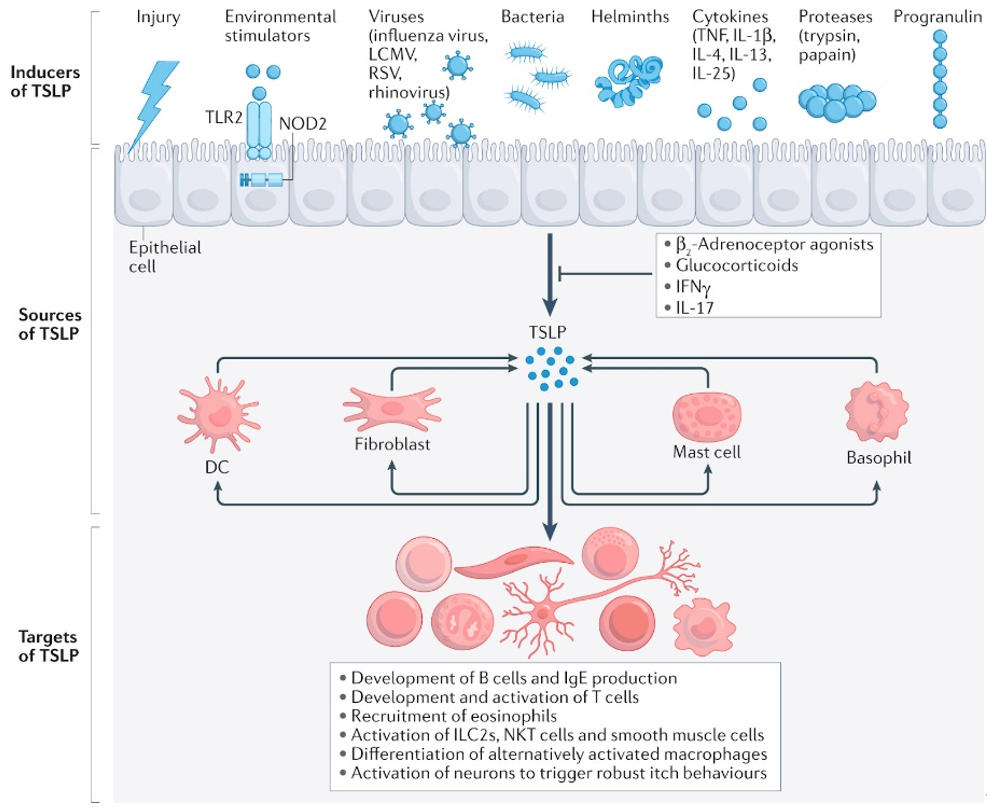
TSLP Generation, Mechanism, and Action Targets[1]
Advances in the Development of TSLP-Targeting Nanobody Drugs
Worldwide research and development progress on TSLP-targeting drugs is primarily concentrated in the field of respiratory diseases, with asthma being the main indication within this area. Other research progresses are found in chronic obstructive pulmonary disease (COPD), atopic dermatitis, chronic rhinosinusitis with nasal polyps (CRSwNP), among others. In contrast, research on drug development for tumor immunotherapy and autoimmune disease treatment lags significantly behind. Research in other fields remains in early stages.
Currently, monoclonal antibody technology dominates TSLP-targeting drugs. Monoclonal antibodies like Tezepelumab have demonstrated clinical efficacy and safety. Bi-/multi-specific antibody technology represents an important upgrade direction for TSLP-targeting drugs, achieving synergistic effects by simultaneously targeting TSLP and other key inflammatory factors. Additionally, numerous studies focus on TSLP-targeting nanobodies, many designed as inhalable drugs. This design not only combines the advantages of the former two but also significantly enhances local drug concentration and safety through the route of administration, providing a novel technical pathway for TSLP-targeting drug development.
- Lunsekimig(SAR-443765): Developed by Sanofi, this is a bispecific nanobody targeting both TSLP and IL-13, with a molecular weight of approximately 75 kDa. It simultaneously blocks the upstream initiation mechanism of TSLP and the downstream effects of IL-13, avoiding pathway compensation seen with single-target blockade. It significantly reduces inflammatory markers like FeNO, improves small airway function, and is effective for both eosinophilic and non-eosinophilic phenotypes of asthma and COPD.
- CXX168:CXX168 is a bivalent anti-TSLP nanobody dry powder inhaler independently developed by HangZhou Chance Pharmaceuticals. Its bivalent structure enhances binding affinity to TSLP and specifically targets the receptor-binding interface of TSLP, preventing its induced TSLPRα/IL-7Rα dimerization. It potently inhibits downstream STAT5 phosphorylation, reduces CCL22 and other chemokine secretion by PBMCs, and suppresses DC-mediated Th2 immune responses. The dry powder inhaler delivery mode allows penetration through the airway mucus layer, deposition in bronchioles and alveoli, achieving local high-concentration sustained blockade of TSLP signaling while avoiding systemic immunosuppressive side effects. It is suitable for patients with mild, moderate, or severe asthma.
- CXX128:Also developed by HangZhou Chance Pharmaceuticals, this is another bispecific nanobody targeting both TSLP and IL-4Rα. It binds to TSLP and blocks the formation of its receptor complex, inhibiting DC maturation and Th2 cell differentiation. Simultaneously, it binds to the extracellular domain of IL-4Rα to block the binding of IL-4/IL-13 to the IL-4Rα/γc or IL-4Rα/Rα1 complexes, inhibiting STAT6 phosphorylation, reducing IgE synthesis, mucus secretion, and airway hyperresponsiveness, thereby achieving dual blockade of inflammation initiation and the core Th2 pathway.
- LQ043H:This inhaled TSLP nanobody nebulizer, independently developed by China's Novamab, precisely recognizes the key functional region of TSLP's four-α-helical bundle structure. Through steric hindrance, it competitively inhibits the binding of TSLP to its receptor complex, blocking JAK1/JAK2-STAT5 and p38 MAPK signaling pathway activation. It inhibits DC maturation and pro-inflammatory cytokine secretion, reduces Th2 cell activation and recruitment, and lowers the release of factors related to non-Th2 pathways, making it suitable for all asthma phenotypes. Administered via nebulization, it achieves localized high-concentration, low systemic exposure precise blockade through the pulmonary capillaries. It has currently entered Phase I clinical trials.
- Ecleralimab:Developed by Novartis, this inhaled TSLP-targeting nanobody has a mechanism of action similar to LQ043H and CXX168. The core difference lies in its optimized Fc region, which extends lung half-life, reduces systemic clearance efficiency, supports lower dosing frequency, and is suitable for long-term asthma maintenance therapy.
Advantages of Nanobodies in TSLP Antibody Drug Research and Development
Due to their small molecular weight and strong tissue penetration, nanobodies can efficiently penetrate dense tissue barriers like the airway mucus layer. They are easily formulated for inhaled, localized targeted delivery, acting directly on lung lesions and reducing systemic toxicity and side effects. Secondly, the ease of engineering nanobodies allows for rapid construction of modular bi-/multi-specific antibodies. For example, Changxi Bio's CXX128 simultaneously targets TSLP/IL-4Rα, inhibiting both TSLP and IL-4/IL-13 signaling pathways to achieve a synergistic blocking mechanism. Furthermore, the ease of production and good stability of nanobodies enable large-scale manufacturing and storage at room temperature, significantly reducing production costs. In TSLP antibody drug R&D, nanobodies offer clinical efficacy improvements and industrialization value that are difficult for traditional monoclonal antibodies to match.
Nabo Life's pDual phage display technology, building upon the efficient development of traditional phage display, seamlessly connects with high-efficiency mammalian cell production, greatly improving the efficiency of screening out problematic molecules. The NabLib® mammalian cell display technology not only enhances the developability of selected molecules but also allows flexible selection of antibody screening formats, providing better assurance for downstream antibody molecule application and detection.