


Core Application Areas of the CD19 Target
Since CD19 is expressed almost exclusively in the B cell lineage and is readily internalized into cells after binding with antibodies, it has become an ideal target for B cell-related malignancies and B cell-driven autoimmune diseases.
Drug development targeting CD19 focuses primarily on B cell-related malignancies, covering conditions such as acute B lymphoblastic leukemia (B-ALL), diffuse large B-cell lymphoma (DLBCL), primary mediastinal large B-cell lymphoma (PMBCL), chronic lymphocytic leukemia (CLL), and mantle cell lymphoma (MCL). Its main applications in this field are targeted therapy and minimal residual disease (MRD) monitoring. In the realm of B cell-driven autoimmune diseases, it covers systemic lupus erythematosus (SLE), neuromyelitis optica spectrum disorder (NMOSD), and multiple sclerosis (MS), achieving treatment by clearing abnormal B cells and inhibiting autoantibody production.
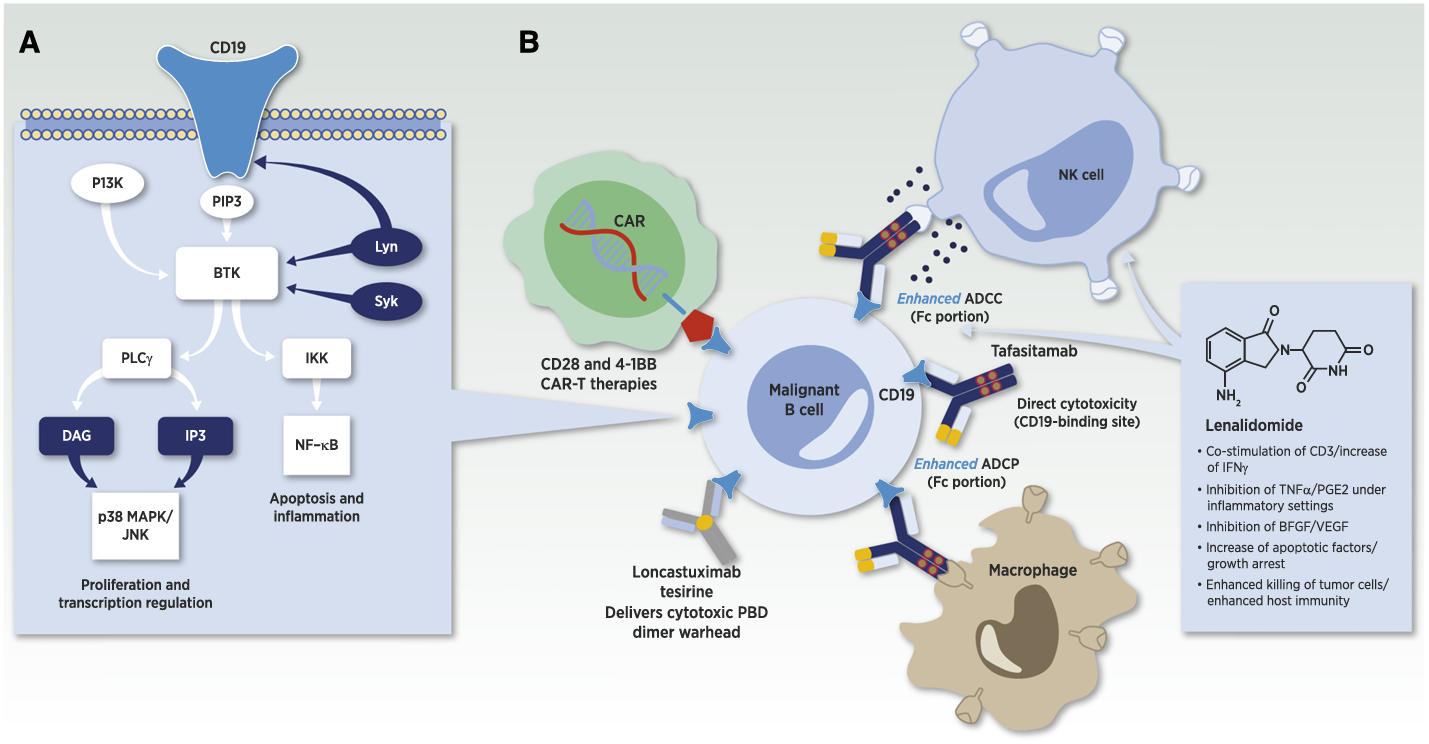
CD19 Signaling Pathway and CD19-Targeted Therapeutic Strategies[1]
Current Status of CD19 Drug Development and Pipeline Progress
Currently, several CD19-targeted drugs have been approved and marketed globally, primarily for indications like B-cell lymphoma and B-lymphocytic leukemia, with the technological focus largely in the CAR-T field. Other drug development paths that have entered clinical stages are generally similar, though a few innovative therapeutic strategies are noteworthy.
CAR‑T/NK Cell Therapies
-
Autologous Cell Therapies: Marketed drugs such as Tisagenlecleucel, Axicabtagene ciloleucel, Lisocabtagene maraleucel, and Brexucabtagene autoleucel require the collection of a patient's own T cells, which are genetically edited to express CD19-targeting CARs for precise recognition and sustained killing of CD19+ tumor cells.
-
Allogeneic Cell Therapies:Unlike autologous therapies, allogeneic therapies use cells from healthy donors for modification, allowing for pre-manufacturing, thereby reducing production costs and preparation time. Examples include UCART19 developed by Cellectis. KN5501, developed by Shenzhen Enrui Kainuo, is a CD19-targeted CAR-NK product for SLE. Clinical trial results from Shanghai Changhai Hospital showed that 67% of patients achieved complete Doris remission with no recurrence.
-
Dual-Target CAR‑T:Dual-target CAR cell therapies aim to address potential antigen loss in single-target treatments, reducing tumor cell escape and drug resistance. Examples include GC012F targeting CD19 and BCMA developed by Gracell Biotechnologies, and JNJ‑4496 targeting CD19 and CD20 developed by Johnson & Johnson, both of which have entered Phase I clinical trials.
ADC Drugs
-
Loncastuximab tesirine is a marketed CD19-targeting ADC drug. After recognizing and binding to CD19, it is internalized into tumor cells via endocytosis, degraded, and releases a PBD dimer toxin that enters the nucleus and forms strong crosslinks with DNA, thereby disrupting DNA replication and transcription and inducing tumor cell death. IKS03, developed by Iksuda Therapeutics, shares the same mechanism of action. SAR3419, developed by ImmunoGen, works by releasing the DM4 toxin after entering the cell to disrupt microtubule assembly, leading to cell cycle arrest and death.
Antibody Drugs
-
Monoclonal Antibodies:Tafasitamab is a CD19-targeting monoclonal antibody for hematologic malignancies. In addition to directly targeting CD19 to promote tumor cell apoptosis, its Fc segment can bind to NK cells, macrophages, and dendritic cells, further promoting the elimination of tumor cells. Another marketed CD19-targeting drug, Inebilizumab, is indicated for neuromyelitis optica spectrum disorder (NMOSD). Through engineering modifications, it can bind with higher affinity to Fcγ receptors on immune effector cells like NK cells, activating them to release toxic granules such as perforin and granzymes, leading to apoptosis of CD19+ cells.
-
Bispecific/Multispecific Antibodies:Blinatumomab is a bispecific antibody targeting CD3 and CD19 for leukemia treatment. Its core mechanism is to tightly bind CD19^+^ tumor cells to CD3-expressing T cells, forming an immunological synapse and directly killing tumor cells without the need for antigen presentation. Obexelimab is a bispecific antibody targeting CD19 and FcγRIIB, primarily for B cell-related autoimmune diseases. After its two arms bind to their respective targets, FcγRIIB transmits signals into the B cell that block the BCR signaling pathway, thereby inhibiting excessive B cell activation, proliferation, and differentiation into plasma cells.
Advantages of Nanobodies in CD19 Drug Development
Preclinical studies have confirmed that the high specificity and affinity of nanobodies can effectively clear tumor cells, with lower immunogenicity and risk of drug resistance. In recent years, numerous drug development projects have adopted nanobodies as a core design concept. The extremely small molecular size of nanobodies grants them ultra-high tissue penetration and targeting capability, allowing them to recognize cryptic epitopes inaccessible to traditional antibodies and reduce off-target effects. They also exhibit stronger endocytic activity in ADC drug development. Their ease of engineering allows nanobodies to be easily linked with multiple domains to form bispecific or multispecific formats, reducing the risk of recurrence and drug resistance due to CD19 antigen escape. Furthermore, their strong physicochemical stability enables them to better adapt to various environments, and their capacity for high-yield expression allows for large-scale, rapid production, significantly lowering production, transportation, and storage costs.

NBLST's pDual phage display technology builds upon the efficient development of traditional phage display by seamlessly integrating efficient mammalian cell production, greatly improving the efficiency of screening out problematic molecules. The NabLib® mammalian cell display technology not only enhances the developability of screened molecules but also allows flexible selection of antibody screening formats, providing better assurance for downstream antibody molecule application and detection.
Simultaneously, Nabo Life offers an off-the-shelf CD19 immune library. After completing alpaca immunization, we collect whole alpaca blood and isolate PBMCs, cryopreserving them as a cell bank. Clients can bypass the lengthy immunization period and proceed directly to the screening process, significantly saving time in antibody molecule development. Through customized screening services, multiple antibody molecules that best meet application requirements can be obtained.